Brass ornamentation Dubai: a workshop buying guide
Brass ornamentation in Dubai is cut, engraved or inlaid to a drawing, so both cost and lead time follow from the file you send. Here is what the workshop makes, what it costs in AED, and how a panel moves from CAD to installed.
Why work with MINGASH ENGRAVING & ORNAMENTATION WORKS EST.
- Drawing-led fabrication with CAD review before cutting
- Hand-cut arabesque and geometric brass work
- Free recut if a finished piece misses the approved drawing
- Engraving, ornamentation and signage in one workshop
- Itemised AED quotes built from your own drawing file
- Direct WhatsApp line to the workshop on +971507710556
What counts as brass ornamentation
Brass ornamentation is decorative brass that is cut, engraved, inlaid or applied as part of the design, rather than plain hardware. Most Dubai enquiries fall into five categories.
Pierced panels
Flat brass sheet cut through with a pattern to leave an open screen. Used for majlis dividers, door overlays, lift lobby cladding and ceiling infill. Pattern density is what drives the cost.
Pierced and engraved panels
The same panel with engraved linework added over the solid areas. It gives relief on a flush surface without extra material depth.
Brass inlay
Brass shapes set into a recess cut in timber, stone or a lacquered panel, then sanded flush. Common in tabletops, reception desks and feature doors. Priced on the inlaid area, because cutting the recess is the slow part.
Applied mouldings and trims
Drawn or extruded brass profiles fixed as borders, frames and reveals. Sold by the linear metre, and usually the cheapest way to add a brass line to a room.
Door and majlis screen overlays
A brass layer fixed over an existing door or screen leaf. Often the practical route for a villa entry door that is already hung and finished on site.
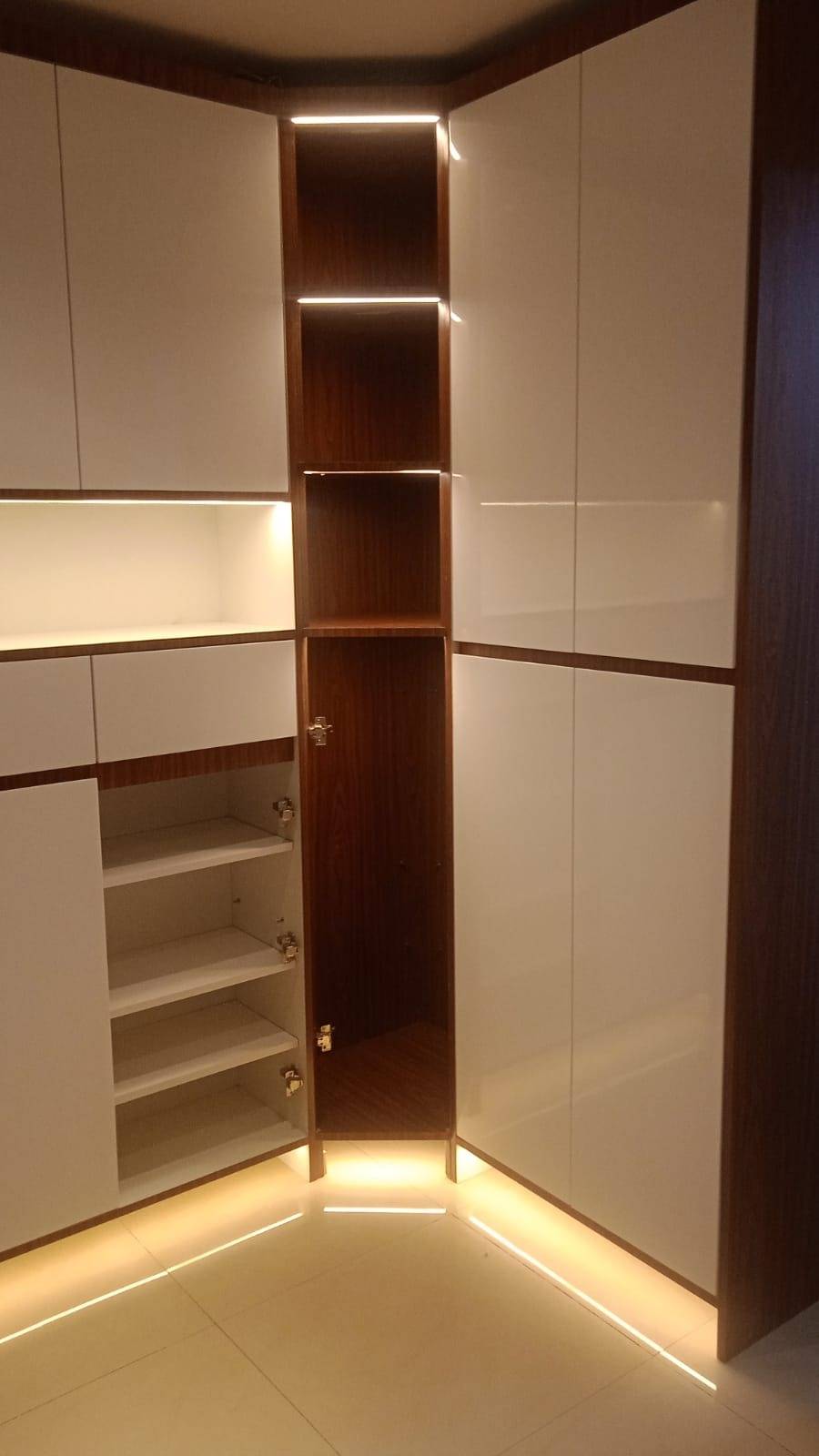 Fitted joinery like this is where brass inlay and applied brass trim usually sit alongside timber.
Where Dubai projects use it
Brass ornamentation suits interiors that want a warm metal line rather than standard fit-out hardware. In Dubai it turns up most in majlis rooms, villa entry doors, lift lobbies, boutique retail fronts, hotel restaurants and bars, and mosque joinery such as screen inserts and minbar panels.
Job specifics follow the building more than the district. A majlis screen inside an air-conditioned villa can stay unlacquered and be allowed to patina. A lift lobby panel or a retail front touched daily needs a lacquered finish and a robust fixing detail. Where the brass forms part of a shopfront or signage, drawings may need the landlord or DET approval route before cutting. If your pattern is closer to a full screen than an overlay, the sibling guide to mashrabiya screen cost in Dubai covers that pricing. We also handle engraving and ornamentation services well beyond brass, in timber and signage.
Hand cut vs laser cut vs CNC stamped brass
Hand cutting holds the arabesque geometry on curves, which is why it is still the default for fine pattern work. A hand cutter follows the drawn line through a tapering leaf and adjusts as the pattern tightens, where a machine follows the file exactly and repeats every flattening in the drawing.
| Method | Best for | Edge and detail | Cost pattern |
|---|---|---|---|
| Hand cut | Arabesque, tapering curves, one-off panels | File-finished edge, control on tight corners | Highest per m2, no tooling charge |
| Laser cut | Repeat flat geometric pattern, thin sheet, volume | Clean and square, small heat-affected edge | Low at volume, setup charge |
| CNC stamped | Large repeat runs, thicker sheet, standard motifs | Uniform, limited fine detail | Low per piece, high setup, rigid pattern |
If the design contains a hand-drawn curve, ask for hand cutting on the sample before the full run is released.
Finishes, and how Dubai heat and humidity treat them
The finish decides how brass ages here, and in Dubai that matters more than the pattern. Antique and brushed finishes hide fingerprints and settle into a soft tone. Polished brass is brightest but shows every touch. Lacquer locks the colour in place.
Unlacquered polished brass near the coast dulls within weeks in summer, because salt air and humidity build a tarnish film quickly. The same finish indoors in air conditioning can hold a bright tone for months. Practical guidance:
- Villa and majlis interiors: antique or brushed, re-polish or wax once or twice a year
- Lift lobbies, hotel F&B and retail fronts: lacquered, wiped with a soft dry cloth only
- Poolside and coastal elevations: lacquered or waxed, with a re-polish every three to four months in the humid season
- Keep the coating intact around fixings, because a broken lacquer edge is where tarnish starts
Temperature is less of a factor than the humidity cycle and the salt in coastal air, so a cheap lacquer is a false economy on any panel a client will touch.
What brass ornamentation costs in Dubai
A 1.2 m by 2.4 m hand-cut pierced brass panel runs roughly AED 2,800 to AED 4,500, depending on pattern density, sheet thickness and finish. That is about AED 970 to AED 1,560 per square metre on that example.
Per square metre bands:
- Open geometric pattern, light piercing: AED 900 to AED 1,200 per m2
- Dense arabesque with fine piercing: AED 1,300 to AED 1,600 per m2
- Pierced plus engraved linework: AED 1,600 to AED 2,200 per m2
- Brass inlay into timber or stone, including recess cutting: AED 1,400 to AED 2,600 per m2
- Applied brass moulding and trim: AED 45 to AED 120 per linear metre
Smaller items are quoted per piece. A door overlay panel at 600 mm by 1,200 mm sits around AED 750 to AED 1,300, and a majlis screen panel at 900 mm by 2,000 mm sits around AED 1,800 to AED 3,200.
Installation and fixing is separate, typically AED 250 to AED 600 per panel for screw-fixed or adhesive-fixed overlays in an accessible interior location. Free-standing screens and high-level lobby work are priced after a site look. A sample piece is usually AED 150 to AED 400 and is credited against the order.
Every panel carries a free recut if the finished piece misses the approved drawing. On pierced work that guarantee matters, because a pattern that closes up in the wrong place cannot be sanded back.
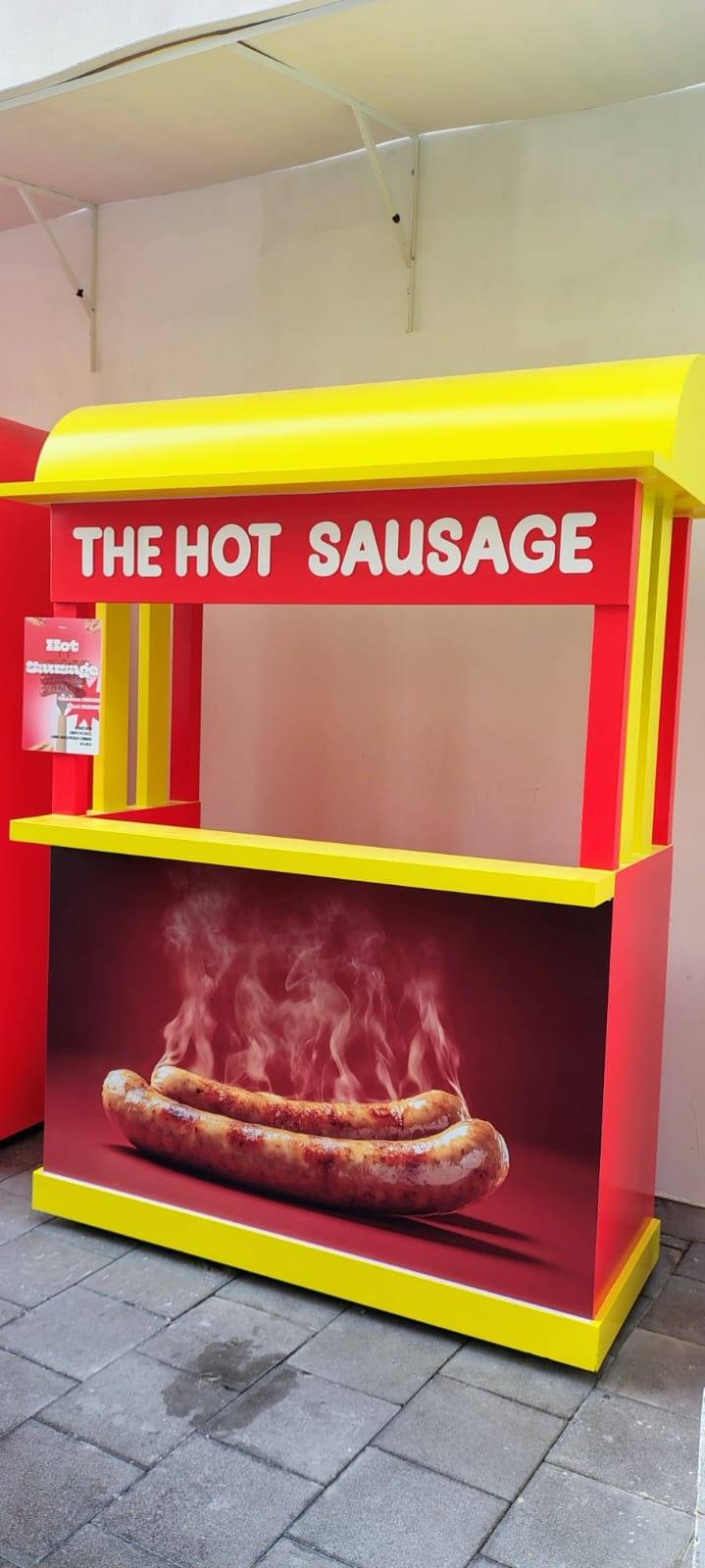 Custom fabricated branded outlet pieces come out of the same workshop that handles brass and signage.
From drawing to installed panel
The process is drawing-led, which is why a quote can come back in a day or two once we have the file.
- Send the drawing or a clear photo of the pattern, with finished sizes in millimetres.
- We review the geometry in CAD, flag anything that will not hold at your sheet thickness, and return an itemised AED quote.
- You approve the drawing, the sheet thickness and the finish.
- We cut a sample so you can check pattern scale and edge quality against the drawing.
- On sample approval we cut the full set, then finish, lacquer where specified, pack and deliver.
- Fixing happens on site, by our team or by your own fitter using our setting-out drawings.
- Where the panel is part of a shopfront or signage, dimensioned drawings and finish specs go out for landlord or DET approval before cutting.
Lead times are 2 to 4 weeks for a single panel and 5 to 6 weeks for multi-panel runs, counted from approved sample rather than from enquiry. Dense hand cutting is the variable, so agree the schedule before the pattern is finalised.
To start, send us your drawing for a brass ornamentation quote on WhatsApp and we will reply with pricing and a cutting date. You can also review brass ornamentation projects from our workshop to judge pattern scale and finish before committing.
Frequently asked questions
How much does brass ornamentation cost in Dubai?
A 1.2 m by 2.4 m hand-cut pierced brass panel costs roughly AED 2,800 to AED 4,500, depending on pattern density, sheet thickness and finish. Per square metre, expect AED 900 to AED 1,200 for light geometric piercing, AED 1,300 to AED 1,600 for dense arabesque, and AED 1,600 to AED 2,200 where piercing and engraving are combined. Installation and fixing is quoted separately, usually AED 250 to AED 600 per panel.
What is the lead time for a custom brass panel in Dubai?
A single panel takes 2 to 4 weeks and multi-panel runs take 5 to 6 weeks, counted from sample approval rather than from enquiry. The sample itself is usually ready in 5 to 7 working days. If your handover date is tight, agree the cutting schedule before the pattern is finalised.
Is hand-cut brass better than laser-cut brass?
For arabesque and tapering curves, yes. Hand cutting follows the drawn line and adjusts where the pattern tightens, while a laser follows the file exactly and repeats every small flattening in the drawing. Laser cutting is the better choice for large repeat flat geometric runs on thin sheet.
How do I maintain brass ornamentation in Dubai humidity?
Wipe lacquered panels with a soft dry cloth and avoid abrasive pads, which cut through the coating. Unlacquered interior panels near the coast need re-polishing or waxing every three to four months in the humid season, while air-conditioned interiors can hold a bright tone for months. Touch in any damaged lacquer around a fixing early, since that is where tarnish starts.
Can you match an existing brass pattern?
Yes. Send a clear photo, a paper rubbing or a measured drawing with panel sizes in millimetres and we redraw the pattern in CAD for your approval before cutting. If the finished piece misses that approved drawing, it is recut free.
Do brass shopfront panels need DET approval in Dubai?
Where the brass panel is part of a shopfront or signage, drawings usually go through the landlord and the DET approval route. We issue dimensioned drawings and finish specifications for that submission. Cutting starts once approval is confirmed.